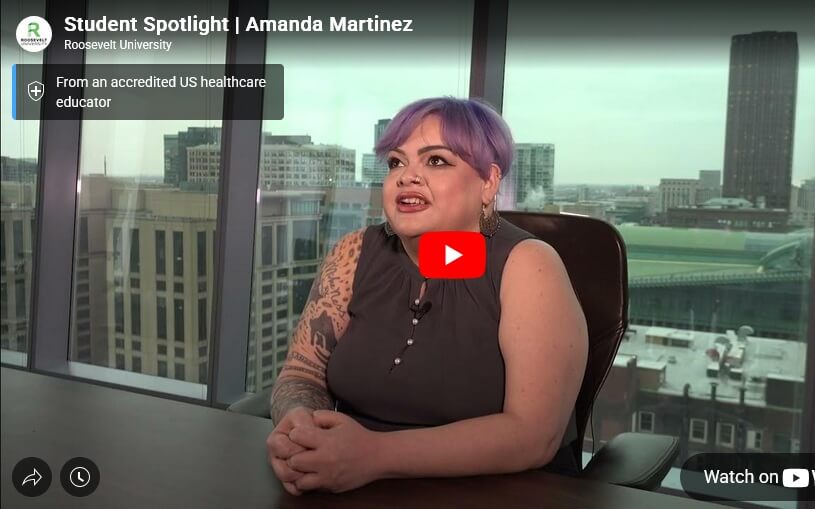
When Amanda Martinez transferred to Roosevelt University from Houston, she brought identities with her that deeply shaped her educational path: first-generation student, non-traditional learner, disabled, queer and mixed-race. At Roosevelt, she says, she finally found “a community that welcomed and empowered” her in ways she had never experienced before.
Martinez’s journey to higher education was far from linear. “I grew up in poverty and didn't exactly have a family life that ever supported my educational prowess,” she shares. Though she excelled academically as a child, she spent 26 years in the trades—first as a fine-dining chef trained at Le Cordon Bleu, then as a high-end hairdresser—until a disability forced her to reimagine her career. “I had to be able to develop a new career path,” she said.
She discovered Roosevelt in an unexpected way. “I actually found out from a pro wrestler that his father attended Roosevelt University, and he kind of sang the praises of that,” Martinez recalled. While visiting Chicago, she walked into the University on a whim, was immediately offered a tour, and “felt like Roosevelt would be right for my next step.”
Once at Roosevelt, Martinez found belonging quickly. “I have so many things that make me unique, but I've never had a single instance at this school where I have in any way felt totally helpless,” she says. That sense of acceptance shifted her self-perception: “I came here thinking I'm so excited just to be a part of this… to feeling that I deserve to be in the McNair Scholars program. I deserve to be in the Honors Program.”
As a non-traditional student, she initially worried she wouldn’t fit in. But within weeks, “people were on a first name basis with me—faculty, students. There are people that I've had one class with that still run down the hall and come say hi to me.” For Martinez, Roosevelt’s culture is key: “You are not seen as just a student of color or just your gender or just your sexuality. You are a person, and you have contributions to bring to the table.”
A pivotal moment came when she reached out to the Dean of Students and Vice Provost Corey Williams during a difficult financial period. “I don't think I could have been any more vulnerable,” Martinez said. The dean, along with Michelle Stipp, Senior Associate Vice President of Financial Aid and Enrollment Services, “worked tirelessly for me to help me find the scholarships to pay off what I needed to.” The support allowed her to return her focus to academics: “Now I can do my homework, because I'm no longer worried about that.”
Academically, Martinez’s path also shifted. She entered intending to study Cybersecurity, but “after conversations with my advisors, we felt that actually my best placement was going to be in Finance.” That change opened new doors, especially through the McNair Scholars Program, where she researches food insecurity in higher education. “I’m doing research and speaking to doctors and professionals, and I'm trying to change the world,” she said.
Her admiration for Roosevelt faculty is unmistakable. She speaks especially highly of Dr. Monique Herard: “Dr. Herard is one of the greatest minds I've ever had an opportunity to meet. She adds, “Not one of the professors is unattainable… they’ve made themselves wholly available whenever I want them.” Martinez made a similar impression of Dr. Herard. Of her time working with Martinez, Dr. Herard had this to say:
“I was very impressed with Amanda. From the first day of class, it was clear that she is a profound and thoughtful thinker who engages deeply with ideas. She immersed herself fully in the course and demonstrated a sincere interest in how the material connects beyond the classroom. Amanda is a natural scholar, and her intellectual engagement and presence enriched the learning experience for everyone. It was a true joy to have her in my class.”
Living and studying in downtown Chicago has also been transformative. “Chicago, I have absolutely loved it,” Martinez says. She appreciates the cultural richness and accessibility: “There is so much happening around us… there are just so many things you can do within just a short space from Roosevelt University.” Chicago has also connected Martinez to her cultural roots. She described a visit to Pilsen to buy pan de muerto for Día de los Muertos: “Just seeing how festive and happy the community was… it just re-enlivened me.” Despite stereotypes about the city, she has felt consistently at ease. “I have felt incredibly safe in this area. I’ve had to get on the blue line at two and four in the morning, and I felt totally safe.” Her advice to hesitant students: “Just get here. Come here for yourself. See it for yourself.” She describes Chicago’s culture in one word: “Legit. If you go anywhere in this city, you are dealing with the realest people.”
To fellow first-generation and non-traditional students, Martinez offers a message of powerful encouragement: “If I can do this, you absolutely can do this. If you're here, you deserve it.”