John Gibbs St. Clair Drake stands as one of the most influential African American scholars of the 20th century. An anthropologist, sociologist and educator, his work reshaped academic inquiry into race, class and urban life. Much of that work took form during his 23-year tenure at Roosevelt University, where he bridged scholarship with social justice in ways that continue to shape the institution today.
Born in 1911 in Suffolk, Virginia, Drake studied at Hampton Institute and later earned his PhD from the University of Chicago. In 1945, he co-authored the landmark study Black Metropolis: A Study of Negro Life in a Northern City with Horace R. Cayton Jr., one of the first major sociological examinations of African American urban life.
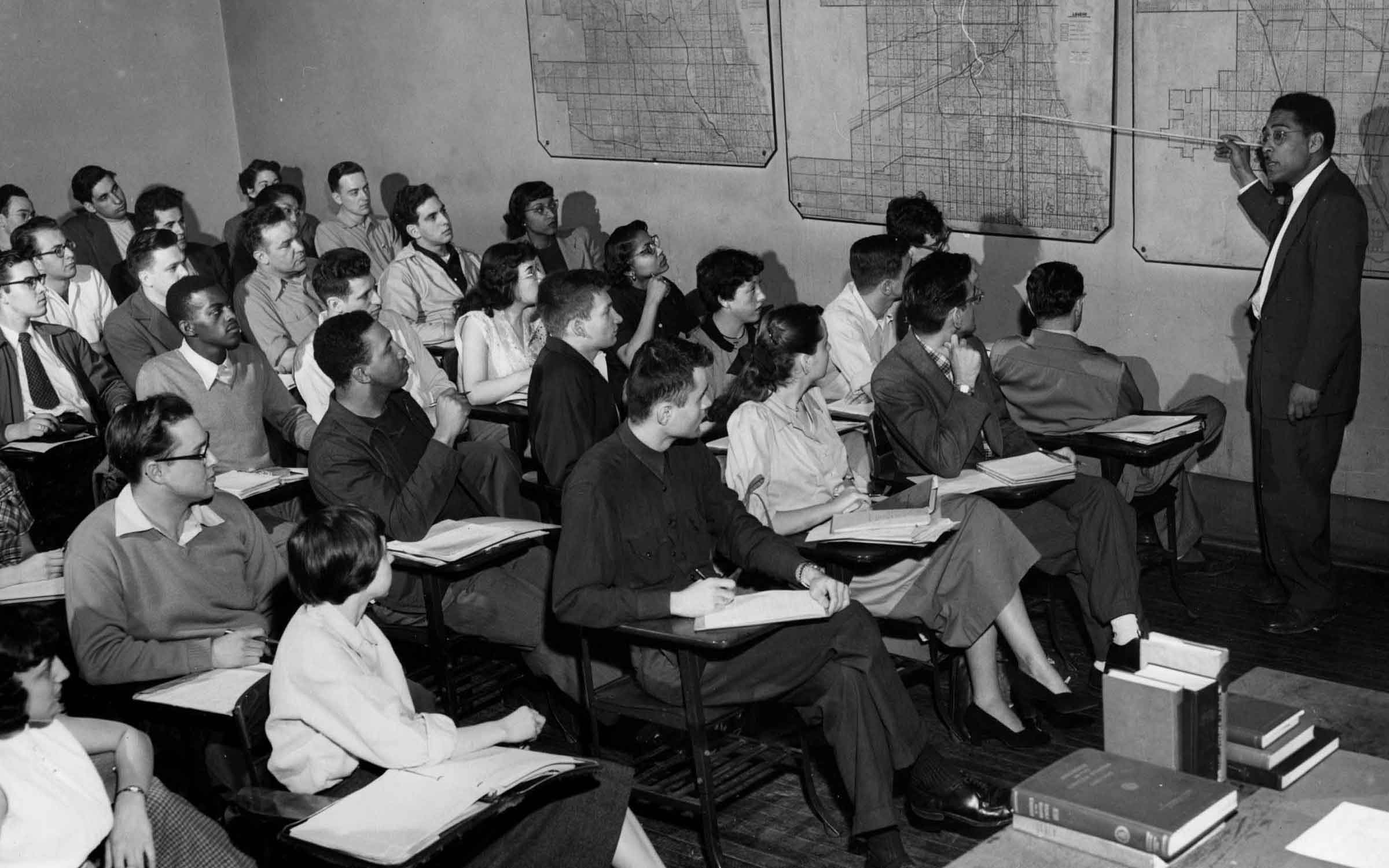
In 1946, Drake joined Roosevelt’s faculty in the Department of Sociology. At a time when few predominantly white institutions extended opportunities to Black scholars, his appointment marked a significant moment in the University’s early history. Chicago became central to both his scholarship and his community engagement.
From 1946 to 1969, Drake was more than a professor. He was a mentor, a public intellectual and community partner who believed social science could combat stereotypes and advance equity. He described his work as that of an “Activist/Anthropologist,” using the tools of his discipline to address the pressing social issues of the day. During his tenure, he helped develop one of the earliest African American studies programs in the United States, laying groundwork for interdisciplinary scholarship that would flourish nationwide.
Even after leaving Roosevelt in 1969 to found the African and African American Studies program at Stanford University, his legacy in Chicago endured. Since his departure, the Roosevelt University Library and Archives have preserved numerous first and second edition texts authored by the scholar, as well as photos from his time at the University. Roosevelt later established the St. Clair Drake Center for African & African American Studies in recognition of his transformative impact.
Today, the Drake Center advances his mission through academics, research, community engagement and leadership development. According to the current Director of the Drake Center, Dr. Al Bennett, leadership at the center has continued the work of Drake by “bringing the academy to the community and the community to the academy.” The Center supports student fellowships, faculty research and community-based initiatives that address discrimination and build cultural and intellectual capital across Chicago.
One initiative housed within the Drake Center is the Robert L. Johnson Leadership Academy, which prepares Chicago high school students for college through immersive academic enrichment and sustained mentorship. Dr. Michael Ford, Co-Founder of the Robert L. Johnson Leadership Academy and Vice President and Chief of Staff at Roosevelt University, shared:
“The Robert L. Johnson Leadership Academy exists because leaders like St. Clair Drake proved that empowering young people, especially those historically marginalized, transforms communities. As a Black vice president at Roosevelt University, I know firsthand how vital it is for our students to witness diverse leadership. It signals that not only do they belong here, but that they can lead here. That is central to our mission and our future.”
The Drake Center also offers faculty fellowships, including support for archival research into Drake’s Roosevelt years. Professor Jacqueline Trussell reflected:
“I was honored to receive the St. Clair Drake Scholarship in the 2015-2016 school year. It provided the opportunity for me to utilize a student assistant to study his archives in New York. Drake maintained boxes and boxes of documents from his Roosevelt years that provided insight into the early days of Roosevelt University and its relationship with Chicago's Black community. Many attended lectures and programs offered by Drake, and others enrolled to pursue their degrees. Learning how Drake helped to propel Roosevelt's presence in Chicago was a wonderful opportunity, thanks to receiving the Drake Scholarship.”
Drake’s legacy, deeply rooted in Chicago and in Roosevelt’s classrooms, reflects the University’s enduring commitment to equity, access and the transformative power of education in advancing social justice.