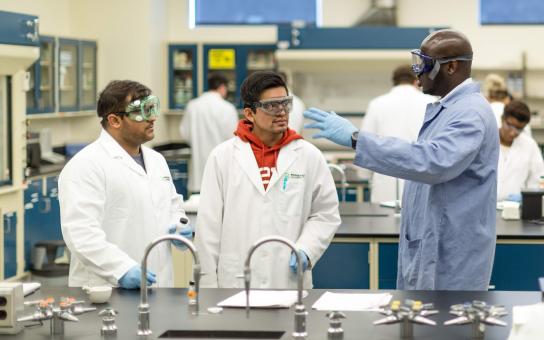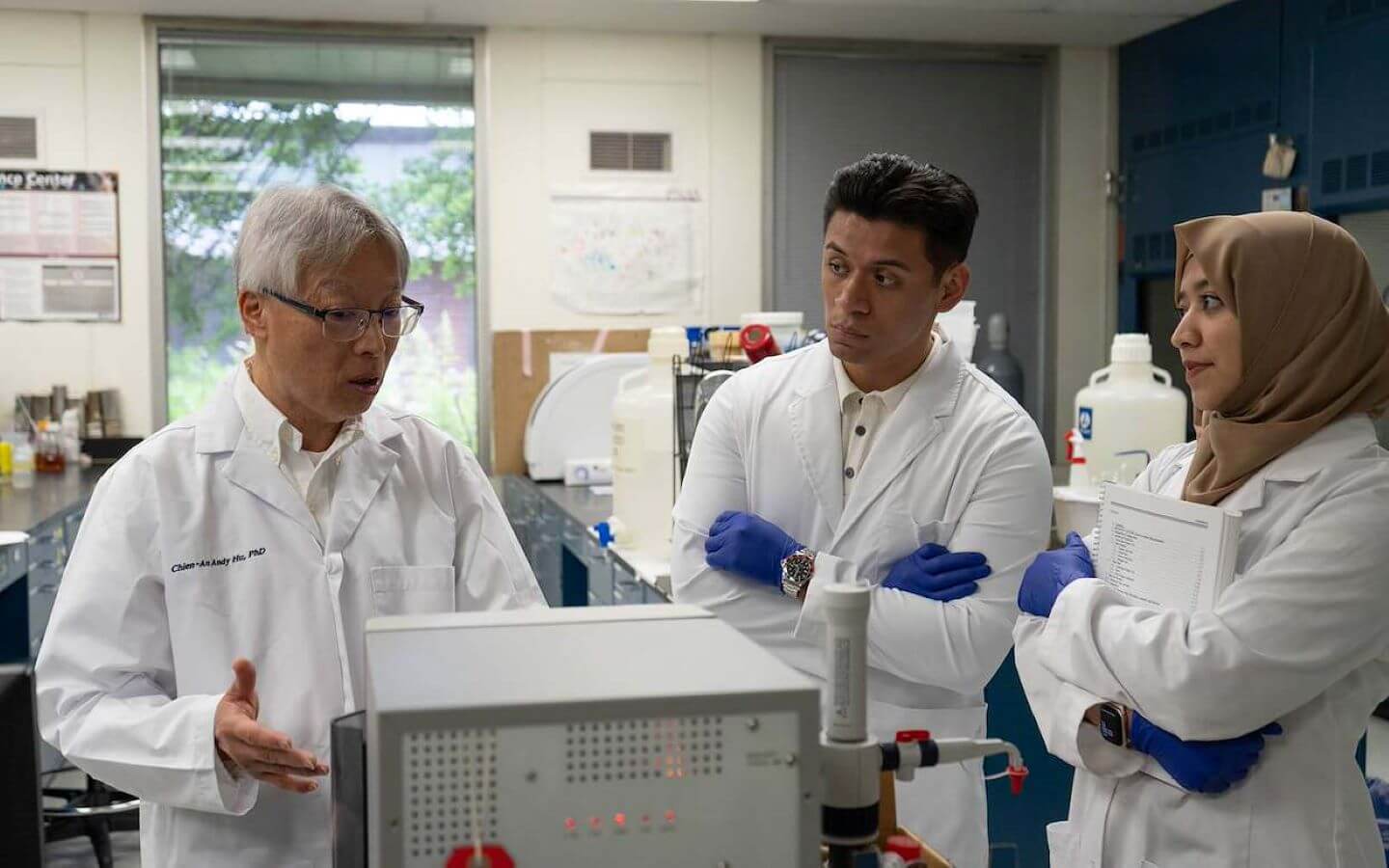
Roosevelt University is giving students the kind of hands-on research experience many don’t encounter until later in their academic or professional careers — pairing advanced lab technology with close faculty mentorship in small, personalized programs. This allows Lakers to bolster their resume for future ambitions and careers, and the lab facilities at Roosevelt University Schaumburg make research accessible for commuters across the Chicagoland area.
Roosevelt’s new Integrated Biomedical Sciences degree is representative of the University’s expanding research opportunities. Established in 2025, the program incorporates mandatory laboratory time into the curriculum and lets students design a research schedule to gain practical experience with sophisticated biocomputing and wet lab equipment.
“Students in this program might want to be a doctor or a professional researcher or drug developer, but you absolutely need familiarity with modern biomedical tools,” says program director Dr. Chien-An Hu. “That’s why it’s beneficial that our program is so hands-on. You can emerge from this University with the confidence to say you developed a sophisticated experimental system while still in school. And because our class sizes are so small, you have plenty of opportunity to specialize and develop your craft.”
Dr. Hu’s research career has focused on disease treatment possibilities by manipulating human genes and proteins, specifically apolipoprotein L6, which is a protein that regulates cell growth and death. By fine-tuning these proteins, scientists can restore the homeostatic balance to prevent unnatural cell growth and death related to cancer, kidney disease and cardiovascular conditions. Thanks to Roosevelt’s extensive molecular, biochemical and biocomputing resources, Dr. Hu and his students can discover potential breakthroughs using these proteins for cancer therapeutics.
“This research process is the beauty of higher education, because the teachers and students create a synergistic team where everyone is constantly learning,” says Dr. Hu. “Because Roosevelt is generous with their lab space and the class sizes are so intimate, we can all become better scientists in a short amount of time.”
Beyond adding lab experience to a resume for future employment, Roosevelt’s research opportunities let students become polished, published writers in internationally regarded scientific journals—a valuable accomplishment early in their careers. When she was deciding on a school for her master’s degree, Biology student Sofiya Azhar recognized that the opportunity to be a published researcher while still in college was exceedingly rare.
“I wasn’t looking for just a degree. I was looking for a school where I could build close relationships with faculty and gain practical skills before entering the workforce,” she says. “Dr. Hu and the research environment at Roosevelt have allowed me to do that.” Sofiya Azhar was also able to present her research at Roosevelt’s annual Research Symposium, where she had the opportunity to meet visiting scientists and learn about research being conducted by students across different departments.
Azhar and her research cohort are also thankful for the convenience of Roosevelt University Schaumburg, which allowed them to conduct research with a minimal commute. “The staff is so welcoming, and the atmosphere is so conducive to research,” says Gary Nunez, a master’s student in Integrated Biomedical Sciences who also works under Dr. Hu. “This Schaumburg campus allows us to combine laboratory time with our more traditional classes, and it’s very accessible for people living in the Chicagoland area.”
Nunez, who plans to attend medical school and become a general surgeon, says this research opportunity has been invaluable for his future career path. “I have direct knowledge of new treatment possibilities and how to work with complicated lab equipment that most modern hospital systems use,” he says. “Physicians need a working knowledge not just of their medical field, but of the pharmaceutical and biological sciences as well. This program and Dr. Hu’s research allow me to learn about all these subject areas, and it will be invaluable as I apply for future positions.”
Roosevelt’s commitment to practical learning and personalized attention with small class sizes has created an invaluable graduate school experience for students like Sofiya and Gary. However, the Integrated Biomedical Sciences is merely one of several programs that let students conduct research directly. The University’s PharmD, Biology, Computer Science and Clinical Psychology degrees all let students use lab equipment and interact with patients to distinguish themselves in their fields. As Dr. Hu says, “Roosevelt looks beyond the textbook and forward into lab, biotech, biopharma and healthcare.”