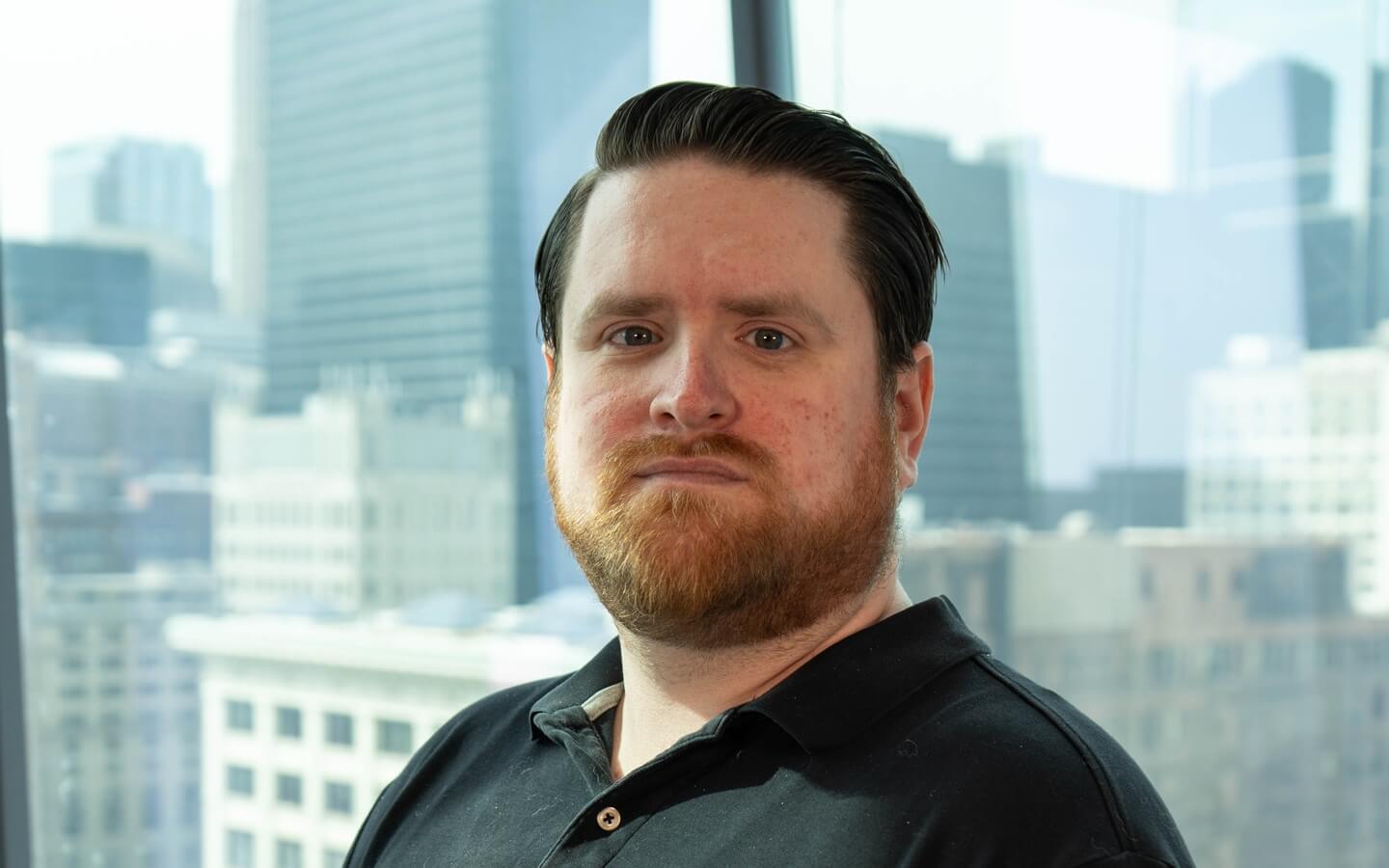
When Computer Science major Mark Devereux chose Roosevelt University, he was looking for an institution that supported his passion for programing and practical experience. Through hands-on learning opportunities, dedicated faculty mentorship and a strong network of support, he found exactly that. One opportunity in particular, Roosevelt's Micro-internship Program, helped launch his growing interest in artificial intelligence research.
Before coming to Roosevelt, Mark spent 10 years working in information technology and systems administration within naval aviation.
"When I joined the Navy, I wanted to do something with computers, but I wasn't really sure what," he says.
The experience inspired him to pursue computer science after leaving military service.
He thought to himself, "When I transition out of military service, I want to do something similar in that field."
After transferring to Roosevelt, Mark quickly found a supportive community. He credits the University's Veterans and Military Center, especially Veteran Success Advisor Karissa Givens, with helping ease his transition to student life.
"When I separated from service, I wanted to find myself again and rebrand in a sense to find my new identity post military service," he says.
He also describes his transfer experience as smooth and welcoming.
"There was a great transfer program that all transfer students go through, and they kind of walk you through all the different programs and opportunities here at Roosevelt."
One of those opportunities came through Professor of Computer Science & Cyber Security
Department Chair Dr. Jerry Schnepp, whose mentorship left a lasting impression.
"One of the first things I knew about him was how [well] he was communicating all these opportunities for computer science students," Mark says.
Last summer, Mark joined a micro-internship research team investigating how people interact with AI chatbots and AI-generated avatars.
"We researched artificial intelligence agents and how users would react to speaking with a chatbot versus speaking to an AI-generated avatar speaking to you back and forth in live conversation time," he says.
As part of the project, Mark developed a custom chatbot called RU Career Coach tailored to Chicago-area job seekers.
"I never made a custom chatbot before, so learning how to do that was really cool," he says.
Equally impactful was the opportunity to work alongside Dr. Schnepp.
"He was sitting there next to us, think-tanking and just getting ideas back and forth," Mark says. "He kind of felt like he was part of the team."
The experience sparked a deeper interest in research that continues through the McNair Scholars Program, where Mark is studying bias in AI chatbots.
"I'm grateful to be a part of the program," he says. "Everyone that I've met so far has just been terrific."
Looking back on his first year, Mark sees a common theme across every opportunity he's pursued.
"There's so many opportunities here, and it came with me just raising my hand, just wanting to get involved," he says. "Now it's turned into all these great things."