Master’s in Integrated Biomedical Sciences, MS
Are you ready to start a career in basic or clinical research or set yourself on the path to a doctorate in the biomedical sciences? Then Roosevelt University's MS in Integrated Biomedical Sciences (MS-IBMS) program is for you.
During your time in the program, you'll engage in hands-on laboratory research and experiential learning to prepare you for careers in areas such as biomedical research, bioinformatics and AI, biotechnology, pharmaceuticals, public health, epidemiology, and more.
The program is offered at our Chicago and Schaumburg campuses. Interested in preparing for health professional school? See our MA in Biomedical Sciences program.
Why Roosevelt for Your Master’s in Integrated Biomedical Sciences?

Interdisciplinary Approach to Biomedical Science
Our program combines multiple scientific disciplines—such as biology, chemistry, pharmacology and medical sciences—to give students a well-rounded foundation in biomedical research and healthcare applications.
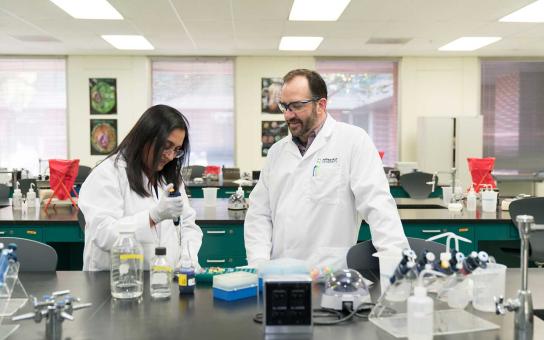
Hands-on Biomedical Science Research Opportunities
Roosevelt emphasizes laboratory research and experiential learning, so you’ll gain hands-on experience in cutting-edge biomedical techniques that prepare you for careers in medicine, research, biotechnology and more.

Personalized Attention
With small class sizes and dedicated faculty, Roosevelt's Master's in Integrated Biomedical Sciences program offers a supportive learning environment where students can get individualized mentoring and academic guidance.
What can I do with a biomedical science degree?
A biomedical sciences degree prepares you for roles in clinical research—such as study coordination, data management, and lab-based investigation—where you contribute directly to trials and translational science. It also provides a strong academic foundation in molecular biology, physiology, and scientific methodology, making it an excellent springboard for competitive PhD program applications.
What is the biomedical science employment outlook?
According to report by Intuition Labs, life sciences research employment has risen about 79% in the last 20 years, compared to only ~8% growth for U.S. jobs overall, reflecting strong demand for biotechnology and biomedical science research experts.
MA vs. MS in Biomedical Science: What's the difference?
An MA in Biomedical Science is a shorter, coursework‑focused program meant to boost your academic profile for health professional schools. An MS is more broad, research-oriented, and lab-based, making it better preparation for research careers or PhD programs.
Meet Your Admission Counselors