Master’s in Clinical Psychology, Counseling Practice, MA
Imagine guiding someone through their most challenging moments and helping them find hope—this is the heart of clinical counseling. Roosevelt University’s master’s program prepares you for impactful work in Illinois and beyond: upon completion, you’ll be eligible to apply for licensure as a professional counselor (LPC, and later, LCPC).
In this comprehensive 60 credit-hour program that includes clinical practicum, you’ll develop foundational skills in psychological assessment and intervention, grounded in the latest theory and research in the field.
Designed for in-person learning over three years, the program offers classes at both the Schaumburg and Chicago campuses, with admissions available for fall and spring terms.
Why Roosevelt for your Master's in Clinical Psychology Program?
Prepare for a Career in Counseling
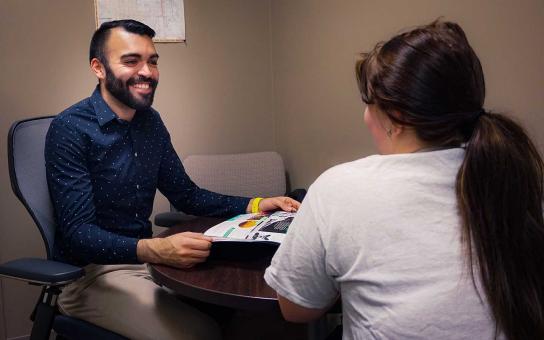
In the master’s of clinical psychology program, you’ll pair two years of course work with a year of supervised clinical experience (practicum). The program has no thesis requirement, but you’re encouraged to seek research assistantships with faculty.
This program will also prepare you to apply to PsyD and PhD programs in clinical or counseling psychology.

Become a Licensed Professional Counselor (LPC)
In Illinois (and most other states), Roosevelt's clinical psychology program qualifies graduates for licensure as professional counselors (LPC) and clinical professional counselors (LCPC). LPCs can work as guidance counselors, family therapists, substance abuse counselors and couples therapists, among other specialties.
Interested in working with children? Learn more about the master’s in school counseling.
Get Practical LPC Training
Through coursework and internships, you’ll gain meaningful firsthand exposure to client advocacy and mental health. Roosevelt's dedicated faculty and advisors will help you choose from our 200+ partner sites that provide mental health services in the Chicago area.
What is the difference between LPC and LCPC in Illinois?
In Illinois and most other states, an LPC (Licensed Professional Counselor) is an entry‐level, supervised license for individuals with a master’s in counseling, while an LCPC (Licensed Clinical Professional Counselor) represents independent clinical licensure after completing additional post‐degree supervised hours and passing the NCMHCE. Our MA in Clinical Psychology equips you with the required coursework, practicum, and clinical training to qualify for both the LPC and, eventually, the LCPC.
Can I become a clinical psychologist with just a master's?
While a master’s degree alone doesn’t qualify you to become a licensed clinical psychologist, it’s an essential stepping stone toward a Ph.D. or Psy.D. Our program equips you with the foundational knowledge, research skills, and clinical experience needed for doctoral studies. Plus, you can achieve licensure as a Licensed Professional Counselor (LPC) or Licensed Clinical Professional Counselor (LCPC), opening the door to meaningful careers in mental health while you prepare for advanced training.
MA vs MS in Psychology: What's the difference?
Both degrees provide a strong foundation in psychology, but an MA typically emphasizes counseling, therapeutic techniques, and applied practice, making it ideal for those who want to work directly with clients or pursue licensure as an LPC or LCPC. Roosevelt's MA program is designed to give you hands-on clinical training and the skills needed for professional counseling or to advance into a Ph.D. or Psy.D. program.
Our Navegando Hacia el Éxito (NHE, or Navigating Toward Success) program is designed to enhance access, support, and success for students considering pursuing a graduate degree in Clinical Psychology, Counseling Practice or in Data Science.
“I chose this program to gain clinical skills and to be able to carry out therapeutic work with confidence. From the moment I started until the end, I have received support from my professors, peers and the program.
I enjoyed learning from my diverse cohort and professors, most of whom are practicing clinicians established in the community. The program emphasizes social justice and issues of diversity.
I am hopeful and optimistic that I, as a future clinician and a Muslim woman of color, will make a difference thanks to my professors and the program. ”
Ayesha Zubedi, MA ’22
Meet Your Admission Counselor