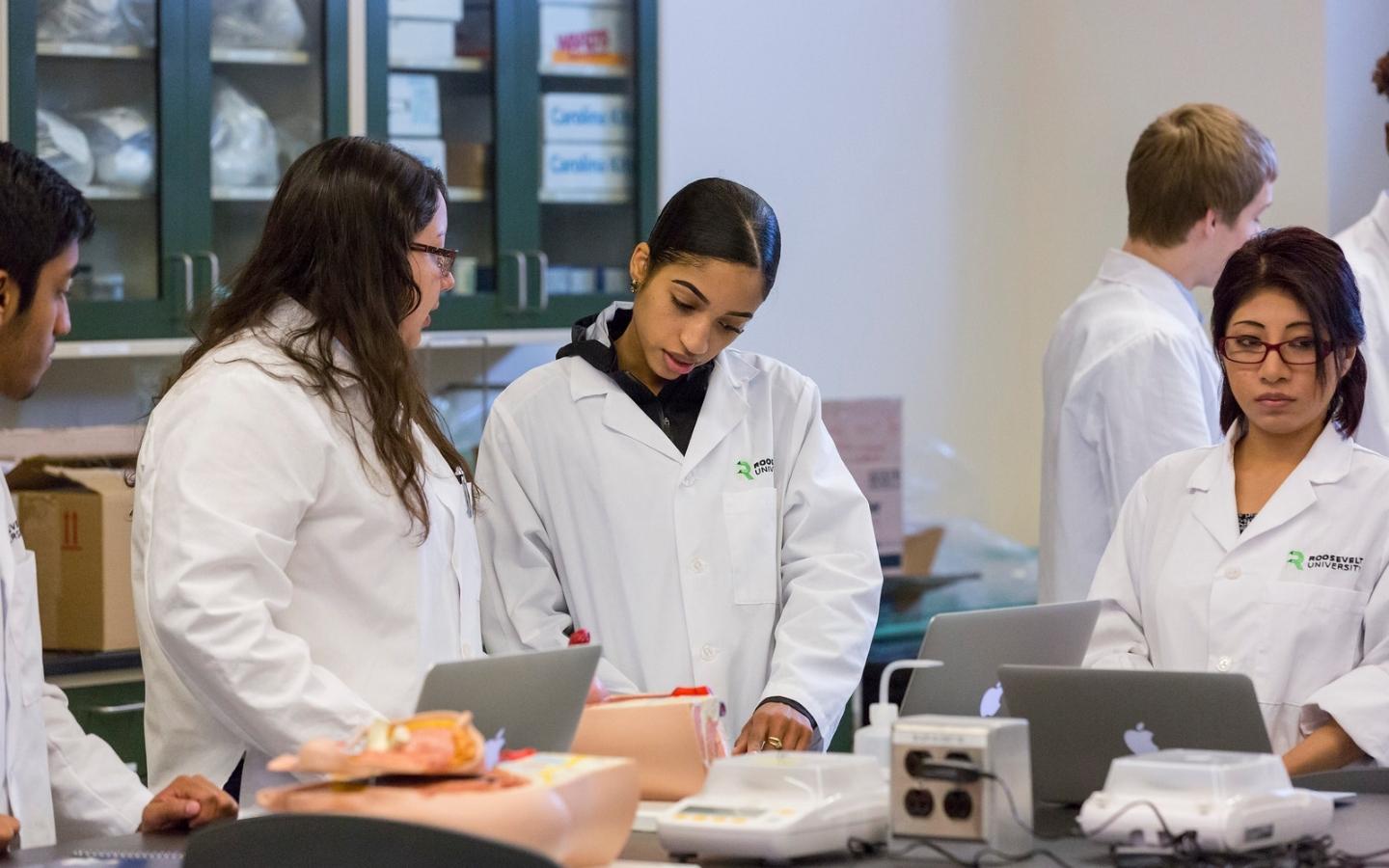
Get a head start on a bachelor’s or master’s degree in science at Roosevelt University. Our College of Science, Health & Pharmacy offers a series of programs in biology, chemistry and health sciences for continuing Roosevelt students and visiting students. These intensive online and on-campus courses include laboratory projects and connects students to expert faculty and industry professionals.
UNDERGRADUATE STUDENT COURSES
Human Biology, Lecture (BIOL 111-01A)
Course Date: June 30, 2026– August 3, 2026
Earned Credit Hours: 3
Course Format: On-Campus Lab (Wabash Building)
Course Description: This course introduces students to basic human biology from molecules and cells to organ systems and even populations. Students will focus on the structure and function of the major human organ systems, including the musculoskeletal, nervous, immune, digestive, cardiovascular, respiratory, urinary, and endocrine systems. Students will also learn about nutrition, human diseases including diabetes and cancer, and genetics.
Instructor: Meiling Lu
Note: Biology major also must register for Human Biology-Lab (BIOL 111-01B) in the same semester.
Human Biology, Lab (BIOL 111-01B)
Course Date: June 30, 2026– August 3, 2026
Earned Credit Hours: 1
Course Format: On-Campus Lab (Wabash Building)
Course Description: This course introduces students to basic human biology from molecules and cells to organ systems and even populations. Students will focus on the structure and function of the major human organ systems, including the musculoskeletal, nervous, immune, digestive, cardiovascular, respiratory, urinary, and endocrine systems. Students will also learn about nutrition, human diseases including diabetes and cancer, and genetics.
Instructor: Meiling Lu
Note: Biology major also must register for Human Biology-Lecture (BIOL 111-01A) in the same semester.
The Nature of Science (BIOL 113)
Course Date: May 26, 2026– August 6, 2026
Earned Credit Hours: 3
Course Format: Online
Course Description: An exploration of scientific inquiry and how it is used to study the natural world and solve problems. Contemporary issues such as climate change, biodiversity, and public health are the basis of class activities and discussions. Students gain experience with scientific methodology and practice, find and evaluate information about science and medicine, analyze scientific data, and examine the role of science in a social context. Fulfills general education requirements for natural science.
Instructor: Norbert Cordeiro
Note: No credit for science majors. Students may take NSCI 102-98 as the accompanying online lab online lab.
Natural Science Lab (NSCI 102)
Course Date: May 26, 2026– August 6, 2026
Earned Credit Hours: 1
Course Format: Online
Course Description: This online laboratory course focuses on scientific inquiry and the study of the natural world. Students gain experiences in the application of the scientific method towards the understanding of concepts in ecology and geography.
Instructor: Elizabeth Bremner
Note: Fulfill the core requirement of Physical or Life Science Lab. The course can be taken concurrently with Physical Geography I or The Nature of Science.
Severe and Unusual Weather (PHSC 104-98)
Course Date: June 30, 2026– August 3, 2026
Earned Credit Hours: 3
Course Format: Online
Course Description: Focus on the meteorological processes that lead to severe and unusual weather events and patterns. Examine thunderstorms, tornadoes, hurricanes, flash floods, drought. and winter storms. Whenever possible, real-time weather data will be incorporated and severe weather events that occur in the United States during the course of our study will be examined. The societal impact of severe and unusual weather will also be studied.
Instructor: Duffy Stuart
Organic Chemistry I (CHEM 211-01A)
Course Date: May 26, 2026– June 29, 2026
Earned Credit Hours: 3
Course Format: On-Campus Lab (Wabash Building)
Course Description: This course represents the first part of a two-semester sequence. Laboratory experiments represent an integral part of this course. Students will learn basic concepts of organic chemistry: nomenclature, structures (including stereochemistry) and reactions of alkenes, alkynes, alkyl halides (electrophilic addition, nucleophilic substitution, and elimination, etc), and alcohols. Students will understand electron delocalization, organic acid and bases, and be able to perform basic laboratory procedures: synthesis, purification, and identification of organic compounds.
Instructor: Oluseye Onajole
Note: Lecture portion of the course will be conducted via Zoom. Must register for Organic Chemistry I (CHEM 211-01B).
Organic Chemistry II (CHEM 212-01A)
Course Date: May 26, 2026– June 29, 2026
Earned Credit Hours: 3
Course Format: On-Campus Lab (Wabash Building)
Course Description: This course represents the second part of two-semester sequence. Laboratory experiments represent an integral part of this course. Students will extend their knowledge of basic concepts of organic chemistry, including the structure, reaction mechanisms, and synthetic uses of a variety of organic molecules, including alcohols, amines, and carbonyl, aromatic, and organometallic compounds. The laboratory includes the synthesis, purification, and identification of organic compounds as well as instrumental methods in organic chemistry.
Instructor: Oluseye Onajole
Note: Lecture portion of the course will be conducted via Zoom. Must register for Organic Chemistry I (CHEM 211-01B).
Introduction to Algorithms (CST 280)
Course Date: May 26, 2026– August 6, 2026
Earned Credit Hours: 3
Course Format: Online
Course Description: Give yourself the keys to computing by learning the basic techniques used to design and analyze efficient algorithms. The major topics include: the divide-and-conquer approach, sorting algorithms, graph algorithms, the greedy approach, dynamic programming, computational complexity.
Instructor: Colin Elkin
Global Health (HCA 300)
Course Date: May 26, 2026– August 6, 2026
Earned Credit Hours: 3
Course Format: Online
Course Description: This course will examine today’s most critical global health issues and trends. Examination will be given to the socioeconomic, biological, and environmental causes and consequences of diseases. Some of the topics covered will include: infectious diseases, nutrition, maternal health, non-communicable diseases, mental health, and injuries.
Instructor: Trish Schultz
Ethical & Legal (HCA 353)
Course Date: May 26, 2026– August 6, 2026
Earned Credit Hours: 3
Course Format: Online
Course Description: This course will look at the ethical and legal issues that affect medical practitioners in a variety of professional settings. Students will gain a foundation for handling everyday challenges in the medical environment. Topic areas will include: credentialing, professional liability, medical malpractice, and end-of-life issues.
Instructor: Amy Dolhay
Ethical & Legal (HCA 353)
Course Date: May 26, 2026– August 6, 2026
Earned Credit Hours: 3
Course Format: Online
Course Description: This course will look at the ethical and legal issues that affect medical practitioners in a variety of professional settings. Students will gain a foundation for handling everyday challenges in the medical environment. Topic areas will include: credentialing, professional liability, medical malpractice, and end-of-life issues.
Instructor: Amy Dolhay
GRADUATE STUDENT OR CERTIFICATE COURSES
Biology & Ethics in Film (BIOL 383 / BIOL 483)
Course Date: May 26, 2026– August 3, 2026
Earned Credit Hours: 3
Course Format: Remote/Zoom
Course Description: End your late spring days twice a week with discussion and critical review of contemporary issues in biology and biomedical sciences based as depicted in contemporary films. Discussions are intended to foster thought and exploration of solutions to problems in health care, biological research, and approaches to combat health disparities.
Instructor: Neil Voss
Network Applications Development (CST 465)
Course Date: May 26, 2026– June 29, 2026
Earned Credit Hours: 3
Course Format: Online
Course Description: Design and programming applications for networks and the World Wide Web; client side and server side processing; the use of a web browser as a client and user interface. Internet protocols such as https, ftp, and ssl and issues such as security, reliability, and management. Course includes programming with JAVA in UNIX and Windows environments. A computer use course.
To register, contact your academic advisor. For additional course details, visit Roosevelt’s Course Finder.
For information on tuition, visit Tuition and Fees.