At Roosevelt University Schaumburg, pharmacy students quickly learn that success is not something they navigate alone. From their first days in the program, they are surrounded by a network of faculty and staff committed to their growth.
That support often begins with access to faculty.
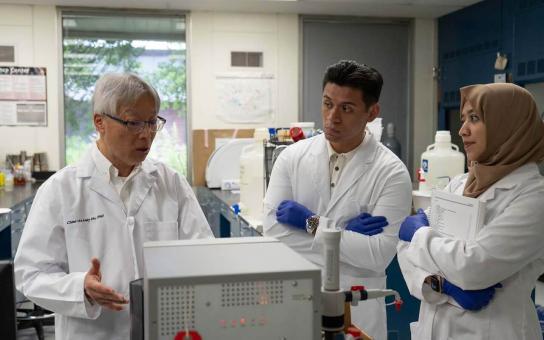
“You can walk down the hallway and their doors are open, and you can walk in and say, ‘I have a question,’” says PharmD student Shirley Hounnou. “Their job is to teach you and to mold you into a good pharmacist.”
For many students, that accessibility makes a lasting impression. Rather than feeling like one of many in a crowded program, students describe an environment where they are seen, heard and supported.
“All the faculty are available. I can email any of them at any time and I know I’ll get a response,” says PharmD student Preethi Srinivasan.
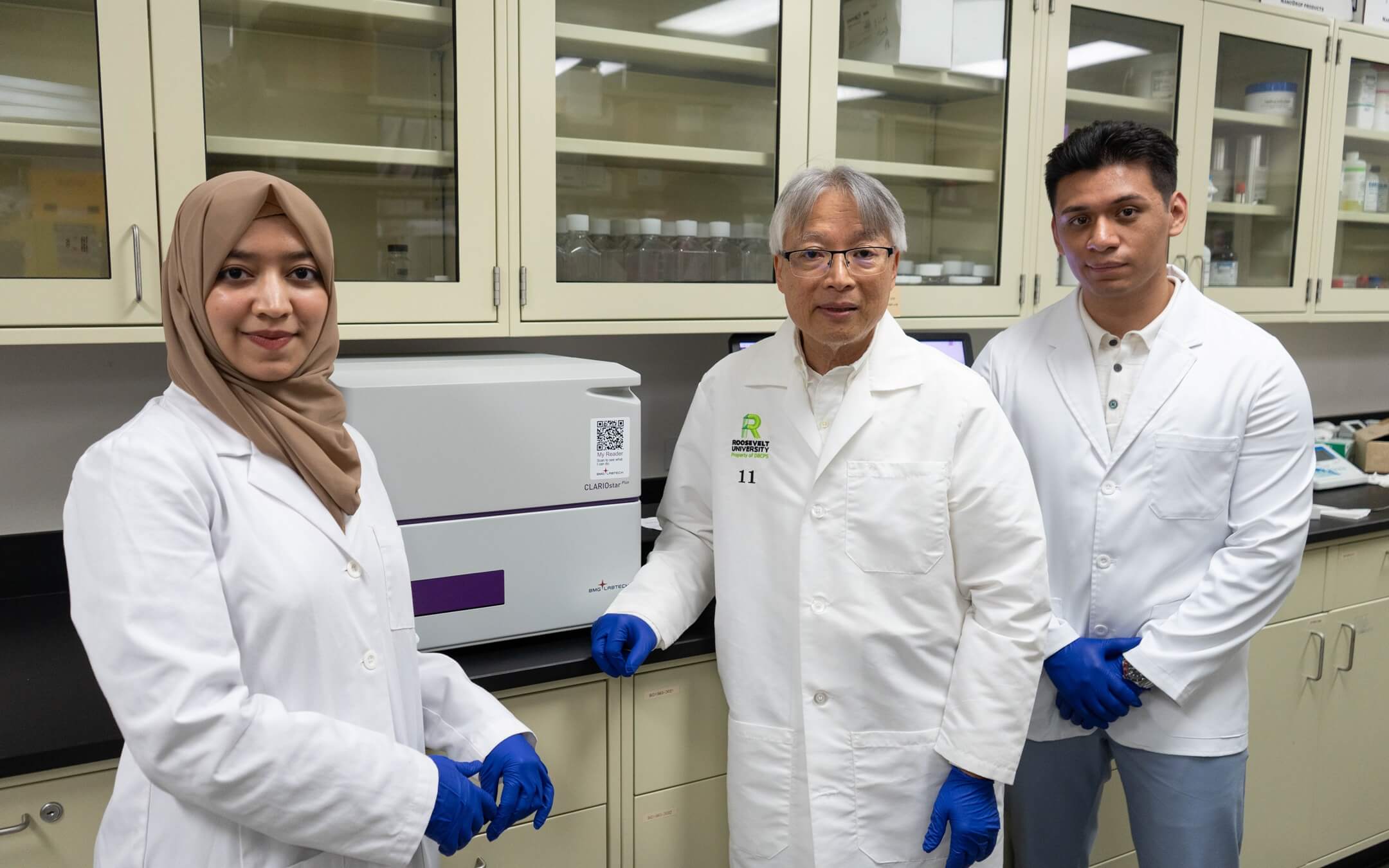
Sometimes, that support comes in small but meaningful moments. “One morning 10 minutes before class, after a simple conversation, Dr. Thakar took the time to draw out a diagram for me, and it really helped put everything into perspective,” Srinivasan said. Of his teaching methodologies, Associate Professor of Clinical Sciences Dr. Nishant Thakar has this to say:
“I’ve been a faculty at Roosevelt for eight years. What I find unique at Roosevelt is the family-like culture. I view our students as professional colleagues who are in the training phase. I feel that philosophy serves as a bridge where students will build trust in the faculty. Students know they have a safe space to talk about course content, professional goals and aspirations, or talk about what’s happening in their lives. I have been fortunate to form bonds with many students that have evolved into friendships after graduation.”
That culture of mentorship extends beyond academics. Students describe an environment where they are encouraged to grow, make mistakes and find their footing.
“I was looking for an environment where I felt comfortable, to make mistakes without getting criticized,” says student Unnati Morker. “It’s a very supportive, very hands-on learning environment.”
For some, that sense of belonging becomes clear almost immediately.
“Within the first month I knew that this is where I belonged,” says PharmD student Matthew Vesely.
For others, mentorship becomes most meaningful in moments of uncertainty.
Faaria Rafat, a nontraditional student returning to school after a decade away, remembers questioning whether she could keep up.
“I was coming back into a math class after a decade. I was like, ‘What have I gotten into?’” Faaria said. “Every day crying in my car saying ‘I can’t do it.’”
That doubt followed her into the classroom until one conversation with Dr. Thakar shifted everything. “I came into his office. I’m just bawling my eyes out saying ‘I can’t do this,’” she says. Dr. Thakar offered a perspective that changed her approach entirely.
“Why are you comparing yourself to other people?” he asked. “You shouldn’t compare yourself to anybody else besides yourself.”
For Faaria, that moment became a turning point, reshaping not only her academic experience but her confidence moving forward.
That kind of mentorship often extends well beyond a single semester.
Roosevelt alumnus Milton Childs Jr., who earned his bachelor’s in biology from the University, credits faculty support with shaping his long-term path. “Dr. Kelly Wentz-Hunter helped me find ways to make that happen,” he says, recalling how the Dean of the College of Science, Health and Pharmacy guided him toward research opportunities and remained a mentor years later.
Across the program, students point to these relationships as the defining element of their experience.
“I was able to ask any questions and get to know professors on a one-to-one basis,” said alumna Anam Qureshi. “The professors go above and beyond to make sure that you’re understanding everything.”
At Roosevelt, mentorship is not an added benefit. It is the foundation of the pharmacy experience, ensuring that every student has the support they need to succeed.