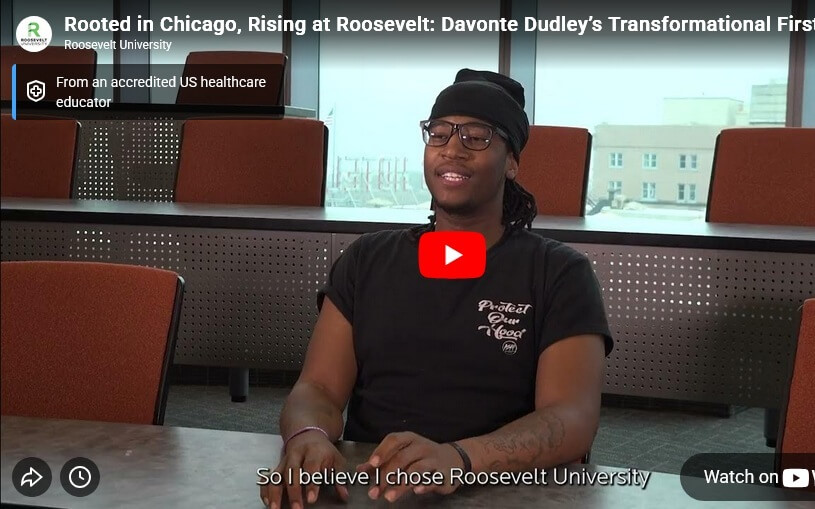
When Davonte Dudley, a Psychology major from Chicago’s Austin neighborhood, reflects on his path to college, he points to years of community organizing as the turning point. His work to curb gun violence and create safe spaces for youth showed him that lasting change requires both action and education. That realization led him to Roosevelt University, where the social justice mission aligned with his commitment to community care. As Dudley put it, “I felt like I needed to get an education to be able to pour into my community, because if you don't fill up your own cup, how could you pour it into anybody else's?”
The decision to attend Roosevelt felt right, even if the initial transition came with challenges. Once on campus, however, Dudley received the support he needed. “The community I found at Roosevelt opened me up to see the different resources that I could utilize,” he said.
Some of that support came from people who made an immediate impact. Executive Director of Student Support Services Riza Belen, his First-Year Success class instructor, helped him adjust to the routines and expectations of college with patience and genuine care. Her guidance made him feel grounded during moments of uncertainty—so much so that he affectionately summed up their connection with, “That’s my dog.” Maria Elena and the Student Support Services (SSS) STEM team also became essential to his experience, offering resources, encouragement and even small acts of kindness like making sure he had snacks between classes. To Devonte, these gestures demonstrated that staff are “actually here for the well-being of you and wanting to see you do better.”
His professors reinforced that same sense of belonging. Dudley praised the humility and care shown by faculty such as Dr. Heather Damage, Dr. Sierra Kane and Dr. Mary Ellen Schiller, explaining that “we're just not tools to help them get paid. They care about our well-being.” Their support helped him remain persistent and confident as he stepped back into academic life.
As the oldest of nine siblings, that confidence carries deep personal meaning. “It not only shows me what I'm capable of, but it shows my family about the possibilities,” he said. His siblings motivate him, hold him accountable and remind him why he chose this path.
Growing up in Chicago further shapes his appreciation for studying downtown. “Some of the things I enjoy about Chicago is like the diversity,” he said. To anyone hesitant about the city, he advises, “You can't believe everything you see in the media. Get your own perspective of Chicago.”
Looking ahead, Dudley hopes to use psychology to empower conversations around vulnerability and healing. His work with Redemptive Plastic continues through his book Lake Store: Learning How to Sit on Your Problems, which explores reflection, sustainability and community care.
For other first-generation students, his message is simple and powerful: “Find the things that matter to you, get a real sense of self, and take time to find that balance.”