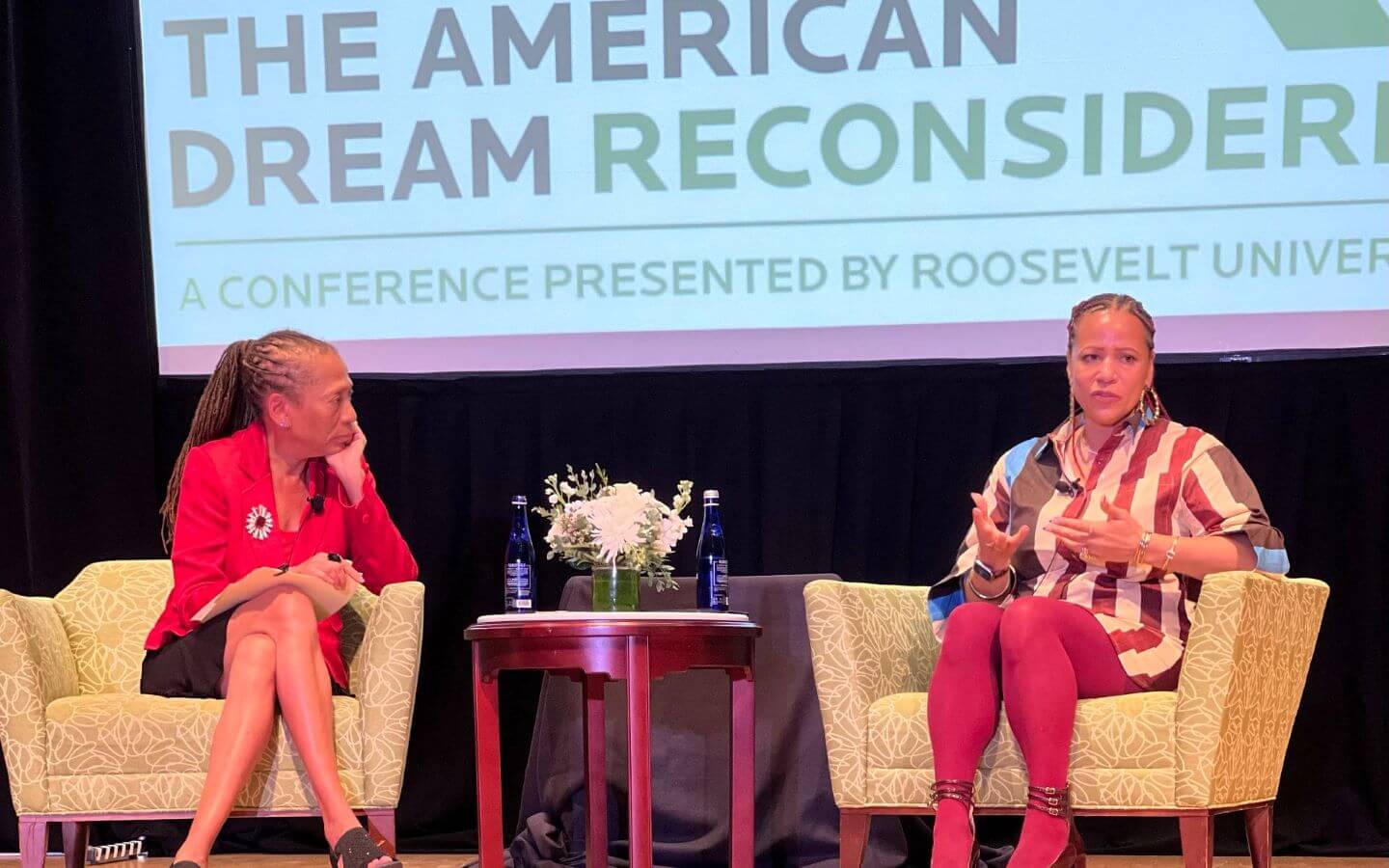
This week, Roosevelt University hosted its annual American Dream Reconsidered Conference—a weeklong gathering for academics, historians and activists to discuss the nation’s past and how it informs the present moment. Students, faculty and staff were invited to attend lively panels and engage directly with visiting speakers (including Pulitzer Prize-winning journalist Nikole Hannah-Jones), and the event aligned with the University’s founding principles of social justice and community engagement.
This year’s conference theme was “250 Years After the Declaration of Independence—A Report Card,” and programming explored the nation’s ongoing struggle to fulfill its founding promise of liberty and equality for all. “The goal of this conference is to think big,” said conference co-chair Margaret Rung in her opening remarks. “We want to talk deeply and philosophically about the values that animate the United States and how we might put those in service to a broader public.”
Rung moderated the session titled “Youth Activism and the Pursuit of Equity and Inclusion,” which focused on the power of youth activism and its significant role in social justice causes such as racial equity, LGBTQ+ rights and gun control. The panel discussed how the urgency and passion of young people throughout political history has resulted in social progress, and that their facility with emerging technology and pop culture means their message is potent when channeled with purpose. Panelist Wesley Hogan, who is a youth activism researcher at Duke University, cited recent examples of French high school students staging walkouts for improved classroom facilities and Indian youth protesting voting role purges as modern examples of youth activism dictating policy.
The following day’s session was “The Conundrum of the American Presidency,” which focused on the second Trump administration’s accrual of executive power compared to what the American Founders intended. The panel—which included Illinois Congressman Mike Quigley—discussed how structural acceptance of Unitary Executive Theory by the GOP laid the groundwork for expanded presidential powers as well as tools to combat this encroachment.
“One of the largest threats this country faces is the elimination of professional expertise and replacing it with partisan bias,” said executive power scholar Heidi Kitrosser. “Eliminating the roles that ensure our health in safety and substituting that for loyalty to the president will be a threat to anyone no matter their political affiliation.”
The conference’s most-anticipated event was “American Freedom in Black and White: Race, Slavery and the Declaration.” Featuring Nikole Hannah-Jones, the interview focused on the racial discrimination inherent in the Declaration of Independence and the inability for the United States to create a truly equal society when its founding was precedented on slavery. Hannah-Jones, whose 1619 Project reframed America’s history through the lens of slavery and Black voices, discussed how slavery’s foundations as an economic proposition made race-based initiatives like Reconstruction and the Civil Rights Act insufficient in combating inequality. But she ended her talk on a hopeful note. “We will always be striving for equality, but there is always the inherent part of our country that we were founded to be,” she said. “However, I think we can do some incredibly powerful things in this county, and I hope we will go out and reject my entire thesis and choose better.”
The conference's final day included a session titled “Voting Rights: A Long Road Behind and a Long Road Ahead.” Panelists discussed prior efforts such as poll taxes and literacy tests to dampen turnout in historically Black districts, as well as how expanding congressional districts across racial and economic lines can force politicians to broaden the scope of their policies. The conference concluded with a virtual session that spotlighted current Roosevelt student activists. Consisting of immigrant rights advocates, progressive political volunteers and community organizers, the panel discussed balancing social media with in-person exchanges as well as the power of unified student sentiment to enact change on campus.
With enthusiastic audience participation and strong attendance, this year's American Dream Reconsidered conference proved to be another successful campus-wide event.